Compliance
Is your Belgian real estate agency website legally compliant? The IPI mentions almost every site is missing
August 17, 2026 · 8 min read
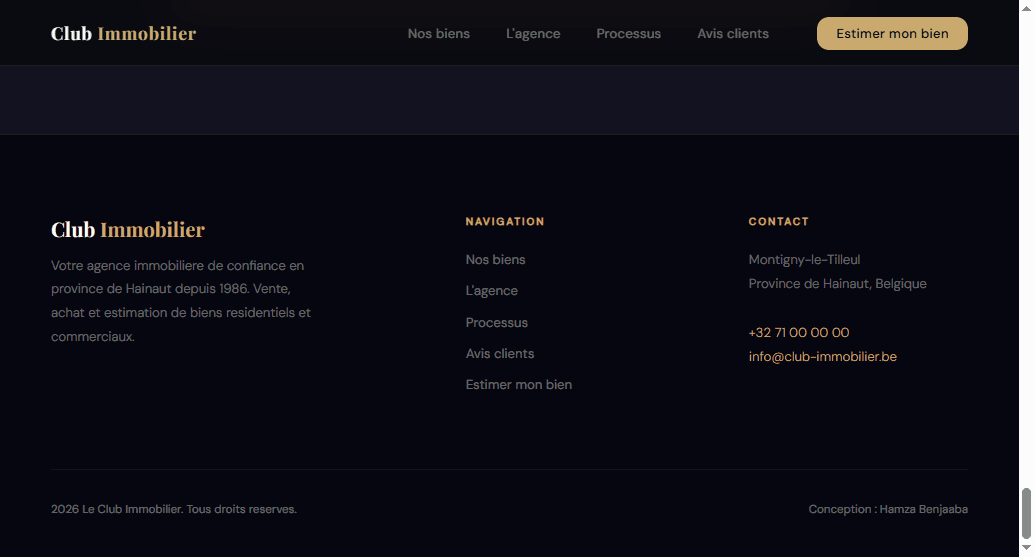
When I introduced Club Immobilier in the original teardown, I described them in one line as “an IPI-licensed agent” — a fact I used to establish that this is a real, accredited agency, not a fly-by-night operation. I never went back to check something that fact actually implies: an IPI-licensed agent's website is legally required to display specific information about that license, and most agency sites I've come across don't.
Unlike the cookie-banner gap I wrote about a few days ago, this isn't a France/CNIL rule — it's Belgian, it comes from the same professional institute (IPI/BIV) that issues the license in the first place, and 2026 happens to be the year Belgium's economic inspectorate is running a sector-wide check that includes exactly this.
The rule, in one sentence
Every IPI-licensed real estate agent's website has to display a specific set of information, every time — not buried once in a “legal notices” page nobody wrote after launch and nobody has opened since.
Per Article XII.6 §1 of the Code de droit économique and Article 20 of the IPI's own code of ethics, a licensed agent's website (and, per IPI's own guidance, their social media profiles too) has to show:
- Professional title, followed by the IPI license number— “agent immobilier intermédiaire,” “syndic,” or “régisseur,” whichever applies, plus the actual number.
- The enterprise number(Banque-Carrefour des Entreprises), preceded by “TVA BE” if the agency is VAT-registered.
- The name of the insurance companycovering the agency's professional civil liability.
- The supervisory authority's contact details— IPI itself.
- The country where the accreditation was granted— Belgium.
- A reference to the IPI code of ethics the agent is bound by.
None of this is a paraphrase from a marketing blog. It's IPI's own published guidance for its members, sourced directly from the professional body that both issues the license and enforces the rule.
Why 2026 specifically
IPI has publicly flagged that the SPF Économie (Belgium's federal economic inspectorate) is running a general control campaign across the real estate sector starting around February 2026. The scope isn't limited to website mentions — it also covers price-display rules, correct BCE registration under the right NACEBEL codes, compliance with the royal decree on brokerage contracts, and anti-money-laundering obligations — but mandatory website mentions are explicitly named as one of the things being checked, and IPI itself coordinates with SPF Économie on it.
Failing to display the required mentions is treated as a deontological breach under Article 20 of IPI's code of ethics. IPI's own disciplinary chamber can sanction that failure on a scale that runs from a warning up to removal from the professional register — I'm reporting that scale as IPI describes it, not attaching a specific euro figure to it, because I don't have one I can stand behind. Unlike the CNIL cookie-banner fines I quoted last week, I haven't found a reliable, specific monetary penalty tied to this particular failure, so I'm not inventing one.
Free resource
Grab the checklist while you're at it
The 15-point checklist I use on every agency covers conversion structure — hero, listings, forms, footer. This legal-mentions check isn't on it, on purpose, for the same reason the cookie-banner check wasn't: compliance and conversion are different audits, and mixing them makes both weaker. Run this one alongside the checklist, not instead of it.
What I actually checked on Club Immobilier — and what I didn't
Here's the honest version: I don't have a finding to report on Club Immobilier's legal mentions, and I'm not going to manufacture one. The original teardown used “IPI-licensed agent” as a one-line credibility marker in the opening paragraph. It never opened the site's footer or looked for a dedicated legal-notices page to check whether the six items above were actually present, and I have no way to re-verify that live in this environment (no live site-fetch capability available when I wrote this piece). So unlike the cookie-banner article, where I had a specific, previously-documented finding to report, this one is the rule and the checklist, not a named finding on a named site. Stating that plainly matters more to me than padding this section with a claim I can't back up.
What I can say from general experience auditing small-business sites, without turning it into a number I haven't measured: a “legal notices” page is often the least-maintained page on an entire site. It gets written once, usually copy-pasted from a template, at launch — and it's rarely revisited even when the agency changes insurer, changes structure, or updates everything else about the site during a redesign.
The five-minute check for your own site
Open your site and look in two places: the footer, and any dedicated “Mentions légales” / “Legal notices” page linked from it. Check for all six:
- Your professional title and IPI number, written out — not just a logo or badge implying accreditation without the actual number next to it.
- Your enterprise number, with “TVA BE” in front of it if you're VAT-registered.
- The name of your professional civil-liability insurer— the actual company name, not just “insured” as a claim.
- IPI's own contact informationas the supervisory authority — not just a link to ipi.be with no context.
- Belgium, stated as the country where your accreditation was granted.
- A reference to IPI's code of ethics— a mention or a link is enough; it doesn't need to be reproduced in full.
If your redesign moved fast and this page got copy-pasted from an old template — or worse, never existed — this is the fastest compliance win on this entire blog: it's copy, not design, and it costs nothing to fix once you know what belongs there.
If you're a French agency instead
Different country, different regulator, different rule — I'm not going to collapse the two into one paragraph and pretend they're the same thing. French agencies operate under the Loi Hoguet framework instead: a professional card (carte professionnelle) number issued by the CCI, a mention of the financial guarantee backing client funds, and — since April 2017 — a requirement to state clearly, on every listing, whether the agency's fee is charged to the buyer or the seller and what share of the price it represents. I haven't gone deep enough into the French rule to write a checklist as specific as the one above without risking getting a detail wrong, so I'm flagging it here as a real, separate obligation worth checking against your own site, rather than folding it into this piece's checklist.
What I'm not telling you
I'm not a lawyer, and nothing above is legal advice. Both the IPI framework and the Loi Hoguet framework have edge cases, exceptions for different legal structures, and details a compliance professional would catch that I won't. What I've given you is the practical version: the same kind of structural check I'd run on any part of a site before touching a redesign, applied here to a page most agencies never look at twice.
Honest note on results:I have no data on what share of Belgian agency sites actually fail this check, and I'm not going to invent a percentage. What I have is IPI's own published rule, IPI's own statement that SPF Économie is checking for it in 2026, and one real, documented reason to think it's worth five minutes: a genuinely accredited agency's website not showing the accreditation it's legally required to show sends the same silent signal as a stale copyright year — that nobody's actually keeping the site current.
Where this fits if you're already planning a redesign
This one sits slightly outside my guide's eight chapters — I built those around conversion and identity, and legal mentions are neither. If you're rebuilding your site anyway, the cheapest place to fold this in is the brief itself: add “current IPI mentions, verified against ipi.be's own list” as a one-line acceptance criterion, the same way I'd suggest adding the cookie-banner check. It costs your developer nothing to get right the first time, and it's exactly the kind of item a generic web agency brief — the kind most agencies still copy-paste — never thinks to include.
Free resource
Run the structural checklist next
Get the 15-point audit checklist and go through the rest of your home page — hero to footer — in about 10 minutes. Compliance is a handful of five-minute checks; conversion is the other fifteen.
Want the full method rather than one chapter of it?“Rebuilding a real estate agency website that converts” is the eight-chapter guide — the 3-second test, the buyer/seller fork, social proof placement, listing cards, the valuation form, identity, technical hygiene, and a launch-week checklist. One-time purchase, $49, on Gumroad — never a subscription.

Hamza Benjaaba
Web designer and no-code developer, specialized in websites for real estate agencies and local service businesses. The “IPI-licensed agent” fact in this article comes from my own original audit of the Club Immobilier site; I did not re-check their legal-mentions page for this piece, and I say so plainly rather than implying an audit I didn't run. The IPI rule and the 2026 SPF Économie control campaign are sourced directly from IPI's own published pages.